This is research from manufacturer documents, not a hands-on test. Confirm the exact hardware revision and included accessories with your installer. Project EV is part of the group linked from Project Better Energy’s website; that does not make Home Energy Compare an authorised reseller.

Which APEX 7.3kW model are you comparing?
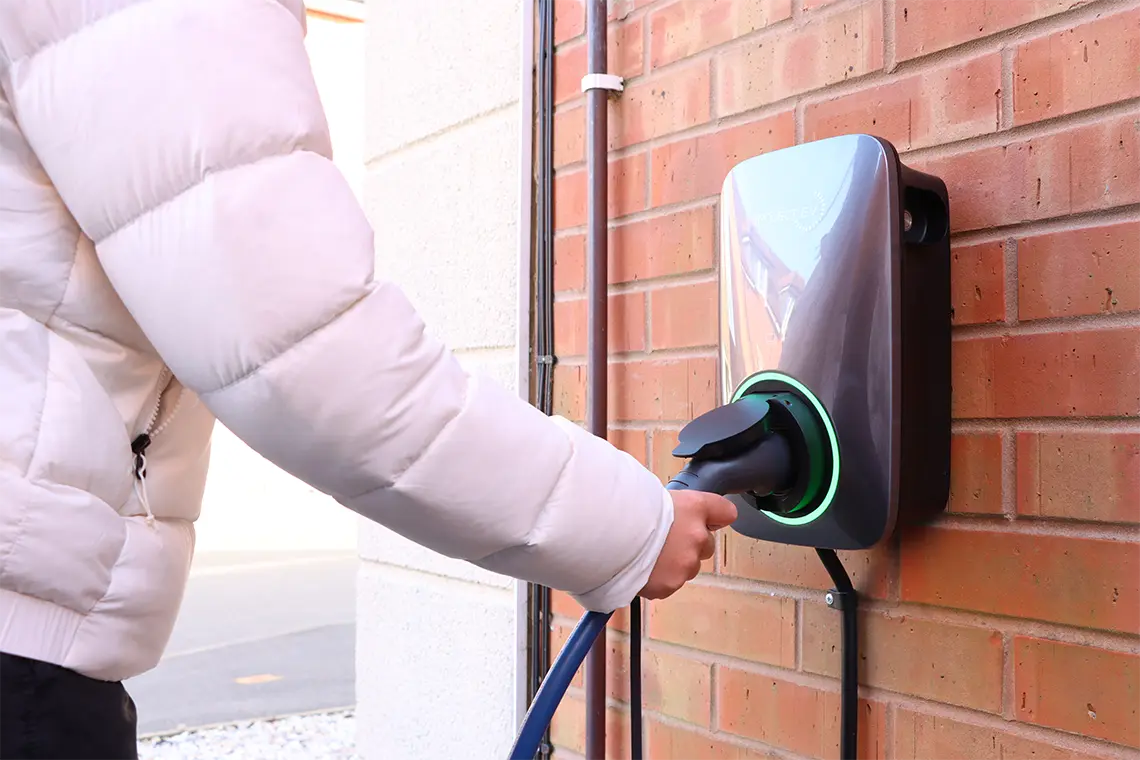
The APEX-S V2.1 datasheet lists 7.3kW, 230V single-phase models alongside a separate 22kW range. The 7S-T has a tethered Type 2 cable; the 7S has a socket. A 4G suffix identifies a cellular variant. The tethered cable is listed at 5 metres. Manufacturer features include solar charging, load management and a five-year warranty subject to terms.
Write the full model code on your comparison sheet. “APEX charger” leaves too much room for different equipment. Tethered means the cable stays attached; a socket version lets you pack the cable away. Think about the charge port’s position when your car is parked normally, rather than measuring only to the driveway’s edge.
The headline rating is not a guarantee that every car will charge at that speed. The vehicle and site also matter. Energy Saving Trust’s charging guide explains charging options and the practical difference between a home charge point and public infrastructure.
What should you ask about solar charging?
Ask the installer to explain three situations: strong sunshine with the car plugged in, passing clouds, and no surplus solar. Request a demonstration of the selected charging mode and what it does when your household starts using more electricity.
If you already have a battery, add one more question: could the car discharge the home battery unintentionally, and how will the controls be configured? This is a whole-system question, not something a charger’s headline specification answers alone.
Check the accessories against the current quote. The V2.1 sheet has a model-specific CT-clamp inclusion note, and says LAN availability depends on supplied stock. Ask for those details in writing instead of assuming every version has the same connections or sensors. The manufacturer’s current document linked here is the reference for those qualifications.
Compare the installation, not just the charger price
There is no installed price quoted in this guide. Two homes can need different cable routes, groundwork and electrical changes. Ask for a written scope with these lines made explicit:
- Exact charger variant, mounting arrangement and cable reach.
- Cable route, trenching or making good, where required.
- Assessment of the supply and all required electrical protection.
- Metering, load-management hardware, setup and commissioning.
- Any permissions or network paperwork, and who completes it.
- Connectivity, subscription costs and aftercare contact.
Ask what would trigger an additional charge after the survey. If you are comparing several quotations, send each installer the same photographs and project brief so the responses are easier to compare. Use our energy planner to organise the starting questions.
What happens after installation?
Project EV publishes an APEX app scheduling walkthrough. It describes setting a charging window in the app’s controlled mode. Ask the installer to show you the process using your own account and confirm how it interacts with any vehicle or tariff scheduling.
Its firmware update guidance, updated in April 2026, explains how to run an upgrade through the app. Keep the model and serial number, commissioning paperwork and support details together so you can identify your unit accurately if you need help.
A product warranty and installation workmanship cover different issues. Request both sets of terms, including registration requirements, labour, call-outs and the process if the installer stops trading. Our view: shortlist the charger when the complete installation and ownership arrangements fit your parking, vehicle and energy plan.
Put your driving into the calculation
Charger hardware is only part of the decision. Use the EV charging cost calculator to compare home, off-peak and public charging for your mileage, including losses. Our charging cost guide explains why a cheaper overnight rate needs a whole-household comparison.
A little more clarity
Questions people ask
Does every APEX charger have 4G?
No. The manufacturer identifies separate 4G model variants. Check the exact model code, service arrangements and any ongoing connectivity costs in your quote.
Does solar-compatible mean charging is always free?
No. Available solar generation and household demand change throughout the day. Ask the installer how the charger behaves when there is insufficient surplus and whether it can draw additional power from the grid.
Is this a hands-on APEX review?
No. This is a source-based buying guide. We have not tested charging performance or long-term reliability and do not assign a star rating.
Published information supports your research. Your installer should confirm the exact product, suitability, scope and terms for your property.
Suggest a correction ↗Your next useful step
Build your EV charging brief
Take the questions that matter to your project, explore the numbers and decide what to ask next.