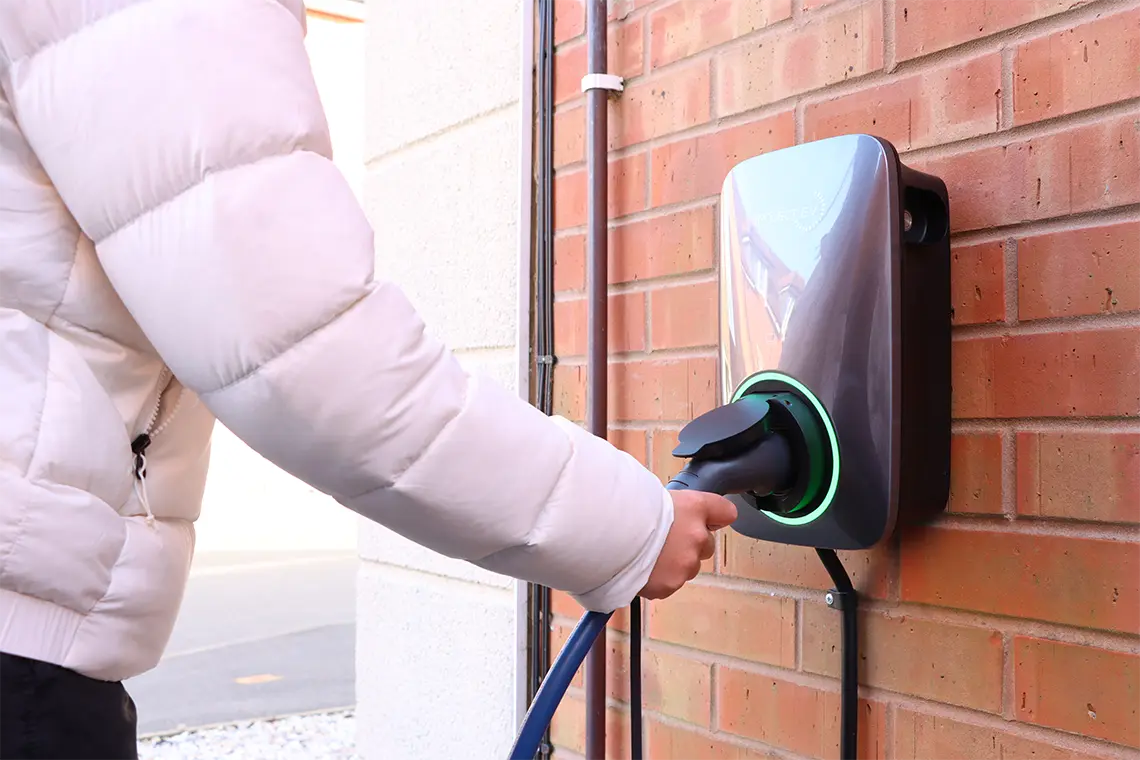
The rates below are illustrative assumptions, not supplier offers. Replace them with your own tariff and driving data. This guide explains electricity costs; it is not a charger review or installation quote.
Our EV charging cost calculator compares standard home, off-peak and public charging. Change the mileage, efficiency and charging mix, then download the full calculation. No email required.
The number on the tariff is only the beginning
To budget for charging, you need annual mileage, the car’s driving efficiency and the price paid for energy in each place you charge. Then allow for charging losses. A dashboard showing miles per kWh normally describes driving energy; it does not mean every unit recorded by the electricity meter reaches the battery.
Keep the units clear. kW is power: how quickly energy can flow. kWh is energy: the amount you buy or store. A 7 kW charge point does not add £7 to the bill, and a large battery does not automatically make every mile expensive.
A worked annual charging budget
Take an example of 8,000 miles a year at 3.5 miles per kWh, with 90% charging efficiency. Driving uses about 2,286 kWh. Buying enough electricity to supply that energy requires 2,286 ÷ 0.9 = about 2,540 kWh. The roughly 254 kWh difference is charging losses.
| Charging assumption | Example rate | Annual electricity cost |
|---|---|---|
| All standard home charging | 27p/kWh | About £686 |
| All off-peak home charging | 10p/kWh | About £254 |
| All public charging | 65p/kWh | About £1,651 |
Those are reference points, not a claim that all your charging can happen overnight. Now assume 80% of charging energy is bought at home, and 80% of that home energy is bought off-peak. The remaining 20% of all charging happens in public. At the same example rates, the budget becomes approximately £602 a year, £50 a month or 7.5p a mile. The calculator shows the three contributions separately.
Check what fits into the cheaper hours
A charger’s badge is not a guarantee of sustained power. Energy Saving Trust explains that the car’s charging capability can limit the charge point. The supply, load management and other household demand can also affect the available power.
Ask what happens when the car charges at the same time as a home battery or heat pump. Compare the hours available and the energy needed before the next journey. If some charging spills outside the cheap period, reduce the off-peak share in the calculation. Do not use the overnight price for all miles simply because the tariff advertises it.
A cheaper car bill can still mean a dearer home bill
Compare the proposed daytime rate and standing charge as well as the charging rate. For example, an extra 3p on 3,000 kWh of other household imports adds £90 a year. An extra 10p daily standing charge adds £36.50. Those two fictional changes would use up £126.50 of any vehicle saving.
Check eligibility for the exact vehicle, charger and meter before switching. Read our time-of-use tariff guide and use the whole electricity bill comparison if you also export solar. For time-varying tariffs, use rates weighted by when your electricity is actually imported and exported.
Take a useful brief to the installer
- Your typical daily miles and the longest regular journey.
- Where the car parks, the cable route and who controls the parking space.
- The car’s AC charging limit and the proposed charger model.
- Whether solar, a home battery or another large load shares the supply.
- The complete installed price, including any required electrical work.
- The warranty, app requirements and arrangements if smart charging stops working.
For a specific hardware example, read our Project EV APEX 7.3kW buying guide. It explains the model and installation questions without assuming that one charger suits every home.
A little more clarity
Questions people ask
How do I calculate EV charging costs per mile?
Divide the electricity rate in pence per kWh by driving efficiency in miles per kWh and then by charging efficiency as a fraction. At 27p, 3.5 miles/kWh and 90% charging efficiency, the result is about 8.6p per mile. These are example inputs, not live tariff rates.
Does buying a faster charger make electricity cheaper?
No. The electricity rate determines the cost per purchased unit. More available power may help fit charging into a cheaper window, but the car and electrical supply can restrict it. Compare installation cost and realistic charging needs.
Does the calculator include installation costs?
No. It compares vehicle electricity costs. Keep charger installation, subscriptions, parking fees and any change in household standing charges separate when making the complete decision.
Published information supports your research. Your installer should confirm the exact product, suitability, scope and terms for your property.
Suggest a correction ↗Your next useful step
Put the information to work.
Take the questions that matter to your project, explore the numbers and decide what to ask next.